← History 11

History 11 · Guilds and the first universities

Guilds

How ordinary people in the Middle Ages organized their work, protected each other, and accidentally invented the university. Click everything on this page. Most of it opens.

c. 900–1500

1Start here: you have a problem

Before we define anything, put yourself in the situation of a medieval laborer facing an injustice at work.

The year is 1220. You are a blacksmith in a middling town in France. You are good at it. For three months you have shod the horses, repaired the armor, and rehung the gates of the local lord.

The bill comes due. He does not pay. He does not intend to. He has a title, a stone hall, and eleven armed men. You have a forge, a wife, four children, and an empty purse.

What can you actually do about it?

Click each one. There are five, and four of them fail.

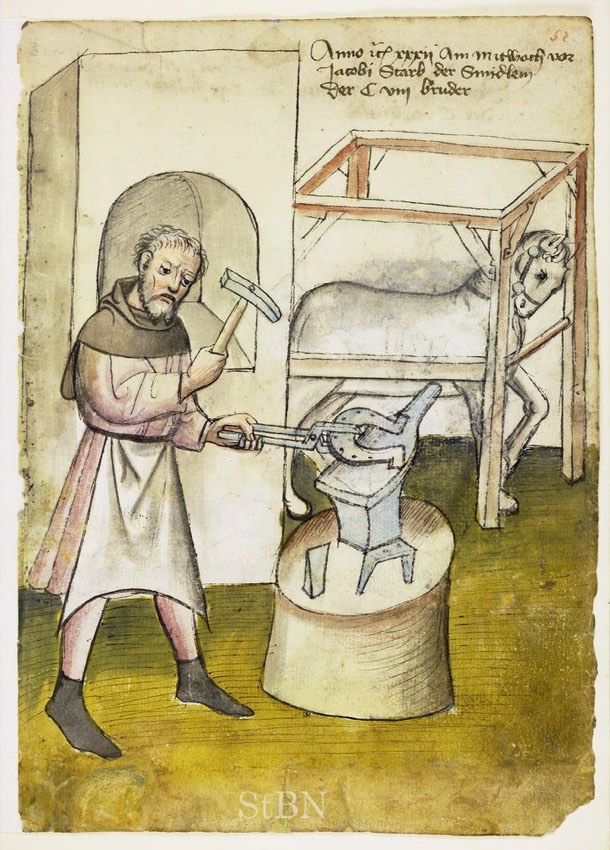
A medieval smith in an apron swings a hammer at an anvil, with a horse standing in a farrier's frame behind him.
A smith at his anvil, drawn in 1432. Behind him a horse waits in a farrier's frame, the wooden cage that held an animal still while its hooves were shod. This is our man from the scenario above, doing the work he did not get paid for.Hausbuch der Mendelschen Zwölfbrüderstiftung, Stadtbibliothek Nürnberg. Public domain.

The point to write down

A guild is what people build where no state is strong enough to protect them. Medieval kings were real, but their reach was thin and their courts were slow. So the people who did the same work swore an oath to each other and became, together, something no single one of them could be: strong enough to be worth paying.

Everything else on this page follows from that. Keep asking one question as you scroll: who protects a worker today, and how is that different?

2So what is a guild?

A sworn association of people in the same work or the same devotion, who trained their own members, set the standards and the prices for a city or region, and defended one another.

Four concepts to remember: Sworn: you took an oath, and breaking it was a sin as well as a betrayal. Trained: the guild, not a school, decided how you learned the craft. Set the standards and the prices: the guild, not the market and not the king, decided what a good loaf was and what it cost. Defended: see above, with the horses.

Where the word comes from. Our word guild traces back to Old English gield (also spelled gyld), meaning a payment, a tribute, or a contribution to a common fund. The name describes the mechanism: members paid in, and the shared fund did the work. It paid for the feast, the chapel, the funeral of a member who died poor, and the fight when a member was wronged.

So a guild starts as a group of people with a common purse and an oath. Everything else grows out of those two things.

3Guilds have ancestors

Nobody invented the guild in a single moment. Two older things were already doing the job. Click either one.

A collegium (plural collegia) was any organization in the Roman world that operated as a legal entity: a group that could own property, hold money, and act as one body under the law rather than as a pile of individuals.

Rome had them for everything. Three examples:

  • Burial societies for soldiers and sailors. You paid in monthly so that if you died on campaign or at sea, you were buried properly rather than dumped.
  • Fraternities of priestly orders, organizing the men who ran a particular cult or temple.
  • Shipbuilders' unions, organizing a trade that Rome could not do without.

Notice what the burial societies already contain: a common fund, a membership, and a promise about what happens to you when things go badly. That is the guild in miniature, a thousand years early.

Monasteries had to feed and fund themselves, so industries grew up inside them naturally. The abbey needed bread, drink, light, ink, and income, and monks had the two things the rest of medieval Europe was short on: literacy and a stable, disciplined workforce that stayed put for life.

Five of them:

Two worth knowing: the abbeys of Leffe in Belgium and Weltenburg in Germany became famous for their beer, and being famous for it meant they controlled the quality and the price in their whole region. Both names are still on bottles today.

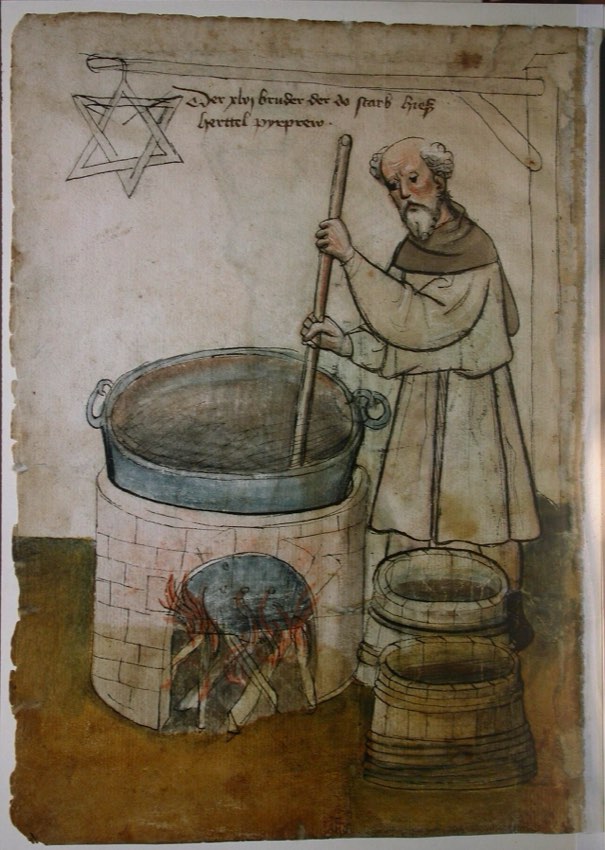
A brewer in a long robe stirs a large vat set over an open fire, with wooden barrels beside him and a six-pointed star hanging above.
Herttel the brewer, drawn about 1425, stirring the mash in a copper set over a wood fire, with his barrels waiting. The six-pointed star above him is the brewer's star, a trade sign hung outside brewhouses across German-speaking Europe to show what was made inside. Trade signs were how you found a craftsman in a town where most people could not read.Hausbuch der Mendelschen Zwölfbrüderstiftung, Stadtbibliothek Nürnberg. Public domain.

That is the whole guild idea arriving by accident. A group with a shared life and a shared discipline makes a good product, and because everyone knows their product is good, they get to say what good means.

4The four kinds of guild

Click a card to open it.

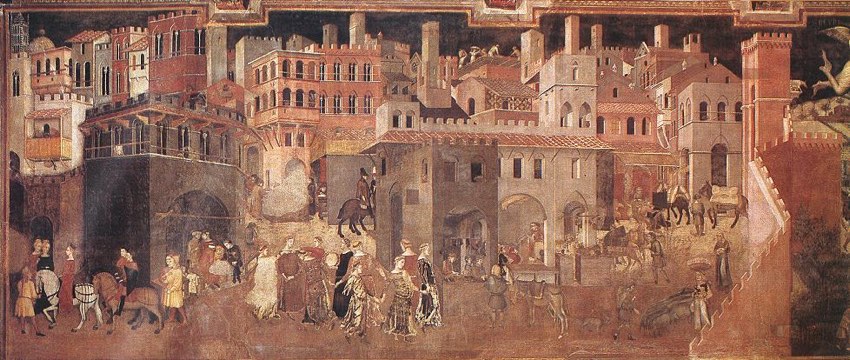
A wide fresco of a walled Italian city with towers, arcaded shops, a man on horseback, dancers in the street, and merchants at open stalls.
A city run by its guilds, painted in Siena between 1338 and 1340. Ambrogio Lorenzetti covered a wall of the town hall with what good government looks like: open shops under the arcades, a teacher with pupils, goods coming through the gate, people dancing in the street. The men who commissioned it governed the city, and the crafts and merchants in this picture are the reason they could.Ambrogio Lorenzetti, Effects of Good Government on the City Life (detail), Palazzo Pubblico, Siena. Public domain.

Definition
A primarily Anglo-Saxon association of peace-keepers: a social club mixed with a police force.
The word
Frith is Old English for peace, and for the protection you are owed inside a group. The name is the job description.
What members actually did
Swore to come when a member called for help, to help track down a thief, and to make good the loss when one of them was robbed. Also to eat and drink together, which is how you make men willing to run toward trouble for each other.
Why it existed
England before the Norman Conquest had no police and a thin royal government. If your ox was stolen, the state was not coming. Your frith guild was.

Today: the closest living relative is a volunteer fire department or a neighborhood watch, where the people who benefit from the protection are the same people providing it.

Definition
Associations devoted to acts of charity, to public processions honoring Our Lady or a particular saint, and to the encouragement of piety.
What they were reacting against
Religious guilds arose in answer to organizations that had sworn themselves to revenge, to persecuting a particular group, or to pushing a faction. Men were already binding themselves by oath to do harm. The religious guild took the same tool, the sworn brotherhood, and pointed it at almsgiving and prayer instead.
What members actually did
Fed the poor, dowered girls who could not afford to marry, buried members who died with nothing, kept lights burning before an altar, and carried their patron through the streets on his feast day.

Today: these are the one type that survived intact. They are today's confraternities (lay brotherhoods attached to a parish or an order, devoted to a particular devotion and to works of mercy). The Knights of Columbus and the parish Altar Society are cousins of the same idea.

Definition
Organizations of merchants and other commerce-related careers that controlled both quality and price within a given city or region.
Who is in it
The people who move and sell goods rather than make them: wool merchants, cloth merchants, spice importers, moneychangers, the men with warehouses and ships.
What members actually did
Decided who was allowed to sell in the town market, what a bale of wool cost, and what counted as honest measure. Alongside the craft guilds they built a system of training and promotion inside their own ranks so that quality and practice stayed consistent.
Why this made cities powerful
A town whose merchants act as one body can lend money to a king, negotiate with another city, and refuse to trade with someone who cheats them. Some of these guilds effectively ran their cities.

Today: a chamber of commerce, a trade association, or a cartel, depending on how generous you are feeling.

Definition
Organizations of artisans producing consumable goods, who regulated both prices and quality within a given city or region.
Who is in it
Metalworkers, smiths, carpenters, , bakers, and . Add weavers, dyers, tanners, coopers, masons, and roughly every other thing a town needs made.
What members actually did
Inspected each other's work, fined shoddy work, fixed prices, limited working hours, and controlled who was allowed to open a shop at all.
Their great invention
The apprentice to journeyman to master ladder, which is section 5 below, and which is the single most durable thing on this page.

Today: the licensed trades. An electrician still goes apprentice, then journeyman, then master, and still cannot legally work unsupervised until a board of people already in the trade says so.

Name that guild

0 of 0

Loading…

5The ladder

The craft guilds built a system for turning a child into a master of a trade. It took about fifteen years. Click a rung.

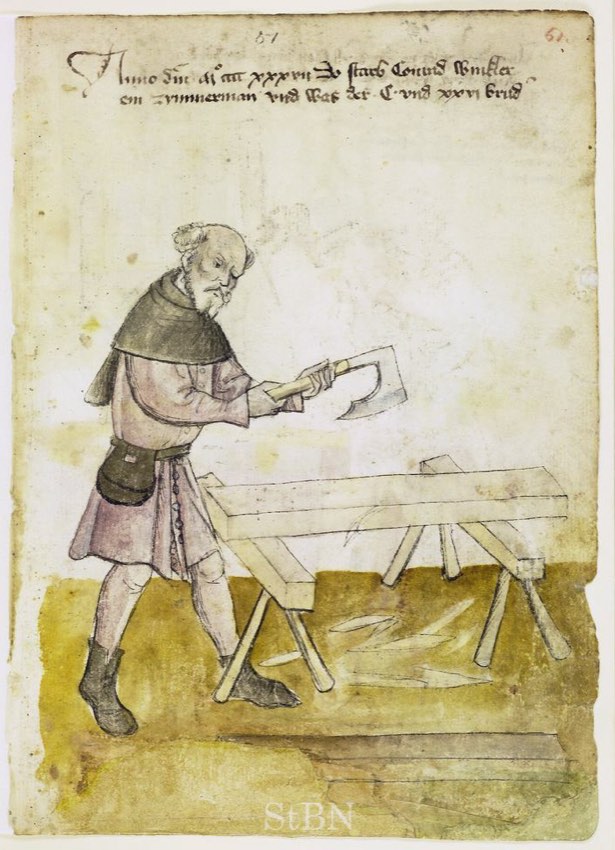
A carpenter squares a wooden beam with a broadaxe on a pair of sawhorses.
Conrad Winkler, carpenter, drawn in 1437. He is squaring a beam with a broadaxe, and he is doing it alone, by eye, with a tool he has swung for thirty years. Nobody reaches this by reading about it. That is the argument for the seven years.Hausbuch der Mendelschen Zwölfbrüderstiftung, Stadtbibliothek Nürnberg. Public domain.

Say it as one breath in the exam: apprentice, journeyman, master.

6What the guild decided for you

Take the bakers, since everyone eats. Here is what your guild controlled. Flip the switch to see the same list from the other side.

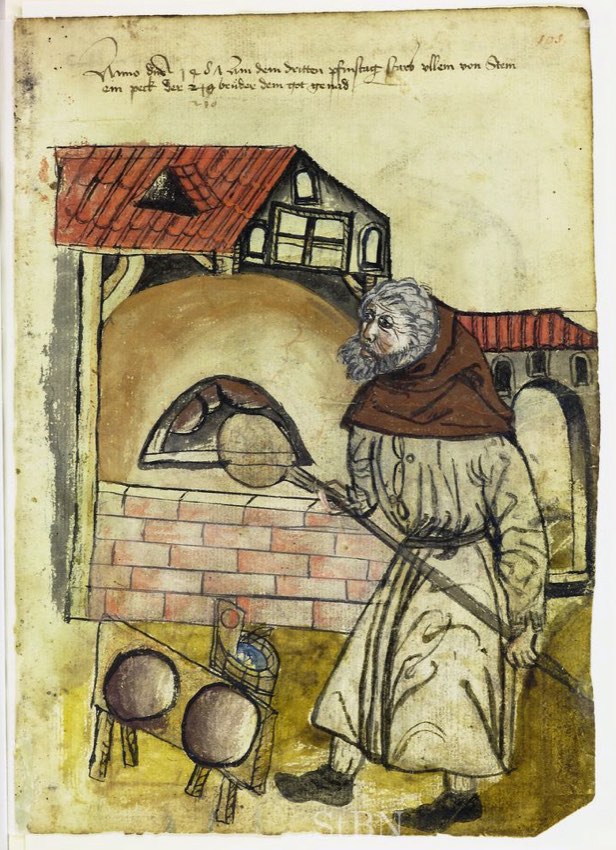
A baker slides a round loaf into a domed brick oven with a long-handled peel, with more loaves stacked on racks nearby.
Ulrich von Stein, baker, drawn in 1487. He is sliding a loaf into the oven on a peel, the long-handled paddle still used today. Look at the loaves waiting on the racks: every one of them had a weight the guild had fixed, and an inspector could turn up and weigh them.Hausbuch der Mendelschen Zwölfbrüderstiftung, Stadtbibliothek Nürnberg. Public domain.
A story worth doubting

England's Assize of Bread and Ale (1266) fixed the weight of a loaf against the current price of grain, so the price of bread stayed steady and the loaf grew or shrank instead. Selling underweight bread was a real crime with public punishments: a fine, the pillory, or being dragged through the streets on a sledge with the light loaf hung around your neck.

The popular story is that this is where the baker's dozen comes from, with bakers throwing in a thirteenth loaf so they could never be caught short. It is a good story and it fits the facts. It is also not something historians can actually document. Hold onto it as a hypothesis, not as a fact, and notice how easily a tidy explanation turns into something everybody "knows."

7What the guilds built

Three consequences. The third one is where the university comes from.

A middle class

Small and prosperous, and new. People who were neither noble nor peasant, who owned their tools and their shops and had money of their own.

Stronger cities

A city full of organized, paying, self-governing craftsmen could fund walls, buy charters, and bargain with kings. The kingdoms that held such cities got stronger too.

The university

The first universities were organized as guilds, by people who had watched guilds work and copied the design on purpose.

The Latin word universitas did not mean a campus or a course catalog. It meant the whole body, the corporation, the guild. A medieval university was formally a universitas magistrorum et scholarium: a guild of masters and scholars. The word we use for a school is a guild word.

And the ladder came with it. An apprentice becomes a journeyman becomes a master. A student becomes a bachelor becomes a master or doctor, and the master's degree is a license to teach, granted by the guild of people who already do. You will collect one of those, in a gown, in a ceremony designed in the twelfth century.

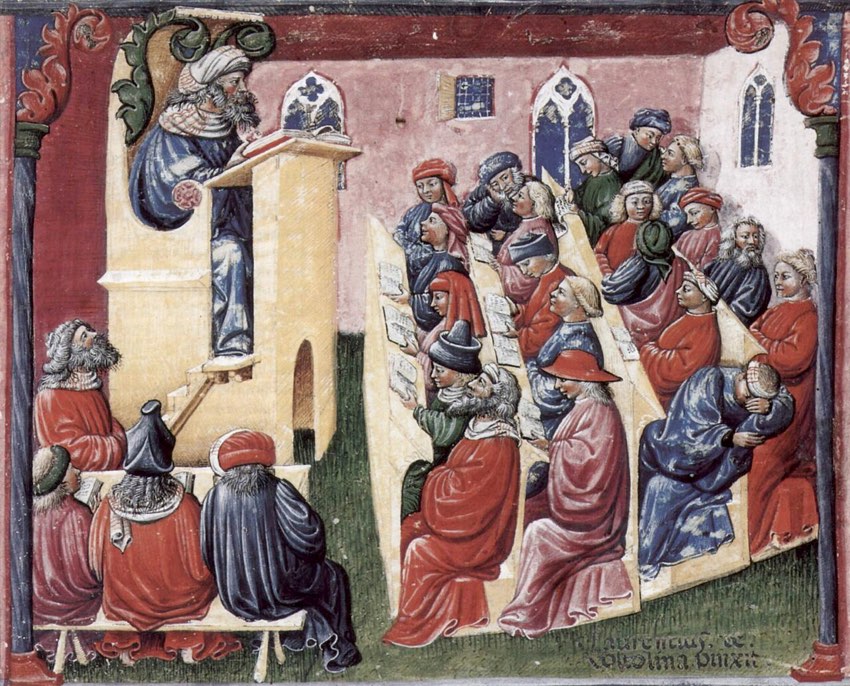
An illuminated manuscript scene of a professor lecturing from a raised pulpit to rows of seated students, some reading, several talking to each other, and one asleep.
A lecture at Bologna, painted around 1350. The master reads from the pulpit. The front rows follow along in their own copies. Now look at the back: two students are talking, one has turned right around, one has his head down asleep, and several are plainly somewhere else. This is the oldest university in Western Europe, six hundred and seventy-odd years ago, and the back row is already checked out.Laurentius de Voltolina, Liber ethicorum des Henricus de Alemannia, Kupferstichkabinett, Berlin. Public domain.

Where they were

Every dot is a school on the list. Drag the year, or press Play, and watch the idea spread from Bologna to St Andrews. Change the lens to see who ran each school, what it was known for, what was spoken in its streets, and where the scholar-saints studied and taught. Click any dot for the whole story of that school. Bologna is the first in Western Europe, and the two after it are the ones to memorize with it.

The map needs the geometry file to draw. The list below carries every school on it.

1420

In every one of these lecture halls the language was Latin. A Scot at Bologna and a Pole at Paris heard the same lecture and understood it. The lens called On the street shows what was spoken outside the door.

The same schools as a list. Click one.

What they taught: seven arts, one picture of reality

Trivium · the arts of the Word
GrammarLogicRhetoric

How to form words, how to reason with them, and how to move people with them. Through words we can speak to every age, class, and kind of man, at any point in history.

Quadrivium · the arts of Number
ArithmeticGeometryMusicAstronomy

Mankind orders the natural world, and speaks with it, through number. Through number we can hold a conversation with the cosmos itself.

A question to hold onto: why is music in the Quadrivium, beside arithmetic, geometry, and astronomy, and not over with grammar and rhetoric?

8“So guilds were just medieval unions, right?”

It is a fair question. Pick one below and compare all three institutions.

Work through a few of those and the shape of the answer appears. A guild does some of what a union does, some of what a licensing board does, some of what a business association does, and some of what a parish confraternity does, all at once, for the same people, under one oath. We have no single modern institution that does all of that, which is why every modern comparison gets part of it right and part of it wrong.

Use the comparison to get started and then say where it breaks. The union analogy in particular carries baggage, positive and negative, from arguments about modern labor that have nothing to do with the twelfth century.

9Questions worth arguing about

Answer one, then press “more” and answer that too. The follow-up is the real question.

Terms

GuildA sworn association of people in the same work or devotion, which trained its members, set standards and prices for a city or region, and defended its own. From Old English gield, a payment into a common fund.
CollegiumRoman. Any organization that operated as a legal entity. Burial societies, priestly fraternities, shipbuilders' unions.
Monastic industriesThe trades that grew inside abbeys: breweries, apiaries, dairies, scriptoria, orchards. Leffe and Weltenburg were renowned for beer and controlled its quality and price in their regions.
Frith guildPrimarily Anglo-Saxon association of peace-keepers. Part social club, part police force.
Religious guildArose in France, later Germany and Spain, in answer to organizations sworn to revenge, persecution, or faction. Devoted to charity, processions honoring Mary or a saint, and piety. Survives today as the confraternity.
Trade guildMerchants and commerce-related careers, controlling quality and price in a city or region, with their own system of training and promotion.
Craft guildArtisans making consumable goods. Regulated price and quality, and developed the apprentice, journeyman, master system.
ConfraternityA lay brotherhood attached to a parish or religious order, devoted to a particular devotion and to works of mercy. The living descendant of the religious guild.
ApprenticeA beginner bound to a master for a fixed term of years, housed and fed rather than paid.
JourneymanA trained worker paid by the day, from the French journée, a day. Free to hire out, not yet permitted to open a shop.
MasterA full member who owns a shop, trains apprentices, and votes in the guild.
MasterpieceThe finished work a journeyman submitted to the guild to be judged worthy of mastership. The origin of the word.
ScriptoriumThe room in a monastery where manuscripts were copied by hand.
ScrivenerA professional copyist who wrote out contracts, wills, and letters.
ChandlerA candle maker.
ApiaryA place where bees are kept, for beeswax candles and for honey.
UniversitasLatin for the whole body or corporation. A medieval university was a universitas magistrorum et scholarium, a guild of masters and scholars.
Assize of Bread and AleEnglish statute of 1266 fixing the weight of a loaf against the price of grain.